




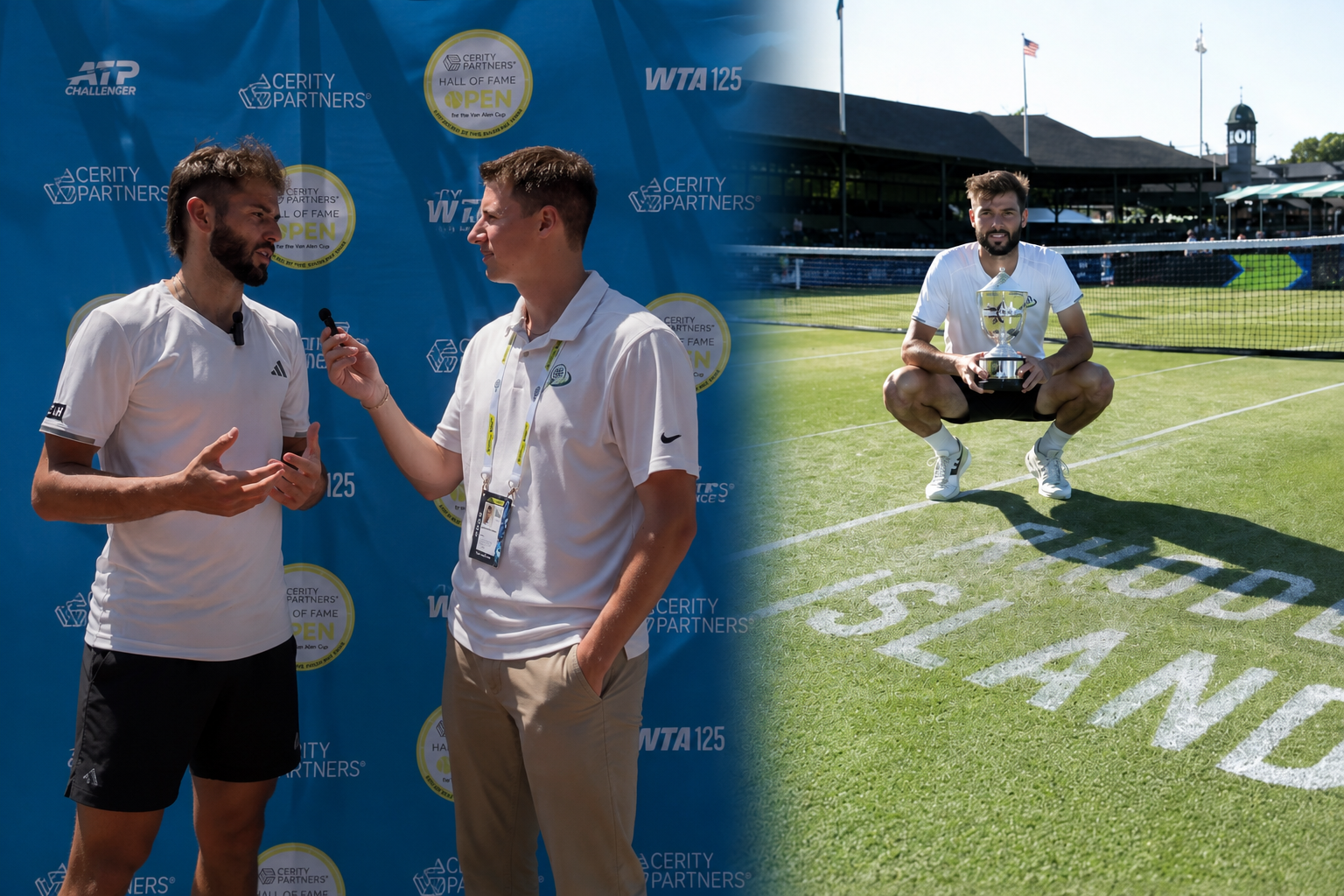
Before the title was his, Jacob Fearnley wasn’t talking about winning one.
When I spoke with the 24-year-old Brit after his opening-round victory at the Hall of Fame Open, our conversation wasn’t centered on rankings, expectations, or the possibility of lifting the trophy a few days later. Instead, Fearnley spoke about enjoying tennis again, maintaining perspective, and managing the demands of life on tour.
Three days later, those themes felt less like interview answers and more like the blueprint that carried him to the Hall of Fame Open title.
For a player whose season had included injuries and a dip in the rankings, it would have been easy to focus on what had gone wrong. Fearnley didn’t.
“Even when the ranking was dropping, it was never really a question of the tennis. It was more a question of my mental state,” he told me. “One of the things me and my team’s been focusing on the most is trying to enjoy life and enjoy playing tennis again.”
He continued:
“It’s very easy to get caught up in rankings… but in reality, if you’re happy and you’re enjoying your tennis, that’s going to translate onto the court and into matches.”
It’s the kind of answer that doesn’t always grab headlines, but it often explains them.
Watching Fearnley navigate the week in Newport, there was a noticeable calm to his game. Whether facing pressure moments or closing out matches, he rarely appeared rushed. His tennis looked free, a fitting reflection of the mindset he had described only days earlier.
That confidence hadn’t appeared overnight.
Just over a week before arriving in Newport, Fearnley produced one of the biggest wins of his career at Wimbledon, rallying from two sets down to defeat Alex Michelsen in his first five-set comeback.
When asked what that victory meant moving forward, he acknowledged how much it could carry into the rest of the season.
“It was my first five-set match coming from two sets to love down against one of the guys that’s established himself in the Top 50,” Fearnley said. “It was a really special win and obviously any win like that is going to give me confidence.”
Then he added something that, in hindsight, proved prophetic.
“Hopefully I can start fresh this week and then onto bigger things.”
That’s exactly what happened.
Fearnley didn’t simply win the Hall of Fame Open, he earned it the hard way. In one of the most dramatic ATP challenger finals of the season, he rallied from the brink against Adam Walton, saving six championship points after trailing 5-1 in the second set. Walton served for the match at 5-1 and again held a 40-0 lead at 5-3, but Fearnley refused to go away. He forced a tiebreak, saved another match point, escaped it 10-8, and eventually completed the comeback in three sets. It was the kind of victory that requires more than clean ball-striking. It demands belief, composure, and an unwavering trust in your game, qualities Fearnley had been describing all week.
Rather than treating Newport as a stop between Wimbledon and the North American hard-court swing, Fearnley used it to build even more momentum, capturing the biggest title of his professional career.
Another part of our conversation revealed just how much perspective has shaped his development over the past two years.When discussing the reality of professional tennis, Fearnley didn’t focus on forehands or backhands. Instead, he spoke about managing his energy away from the court.
“One thing that I’ve learned is to conserve my energy,” he said. “Going and doing things that I enjoy… because energy conservation is the big thing. If you can conserve your energy, you’re going to give yourself a chance to play well.”
It’s a reminder that success on tour isn’t built solely during practice sessions. Recovery, routine, and mental freshness are often just as important as technical improvements.
Perhaps the most revealing answer came when discussing the fact that he’ll have to play qualifying at this year’s US Open after earning direct entry into each of the previous six Grand Slams.
Many players might have viewed that as a disappointment, but Fearnley didn’t.
“I’ve been out of college for two years… If you’d asked me then whether I’d take being Top 150 in the world and playing US Open qualifying, I would 100% say yes.”
He finished with a perspective that seems to define where he is in his career.
“Any time I get to play a Grand Slam, it’s a privilege.”
Those comments may not have predicted a Newport title, but they explained how one became possible.
Looking back at our conversation earlier in the week, it’s striking how little Fearnley spoke about results. He talked about enjoying tennis again, perspective, conserving his energy and appreciating the opportunity to compete. Then, when his biggest test of the week arrived, those ideas weren’t just talking points, they became his greatest strengths. Saving six championship points in an ATP challenger final requires belief as much as talent. By Sunday’s final, the trophy simply became the latest reward for that mindset.
Discover more from Simonsaystennis.com
Subscribe to get the latest posts sent to your email.